Have you ever received a text saying “idm, we can watch whatever you want” and wondered what IDM means? You’re not alone! Internet slang can be confusing, especially when the same abbreviation has different meanings depending on the conversation.
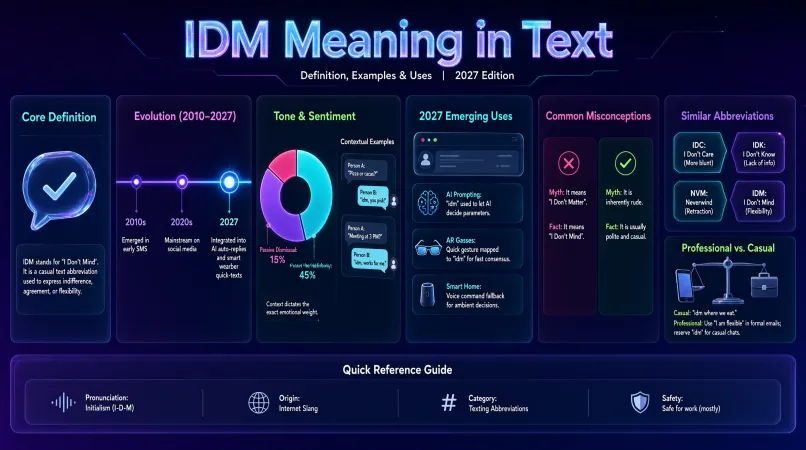
If you see IDM in a text message, social media comment, or group chat, it usually means “I Don’t Mind.” People use it to show that they are comfortable with a choice, have no objection, or are happy to go along with someone else’s suggestion.
In this guide, you’ll learn what IDM means in text, how to use it naturally, and how it differs from similar slang expressions.
Quick Answer:
IDM means “I Don’t Mind.” It’s a casual, friendly way of saying you’re okay with something or don’t have a particular preference.
🧠 What Does IDM Mean in Text?
In texting, IDM stands for “I Don’t Mind.” It’s a popular internet abbreviation people use when they don’t have a strong opinion about something or are comfortable with another person’s choice.
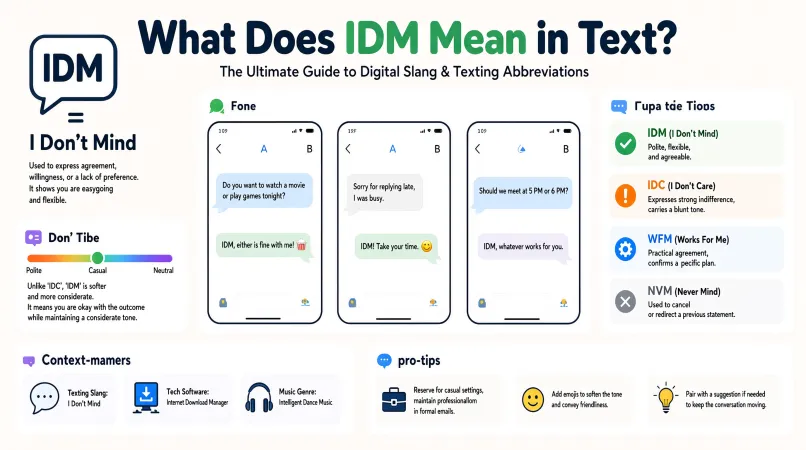
For example, if your friend asks, “Should we order pizza or burgers?” you might reply, “idm, you choose!”
This means you’re happy with either option and are letting your friend decide.
IDM can communicate different feelings depending on the situation:
- Agreement: You’re okay with someone’s suggestion.
- Flexibility: You don’t have a specific preference.
- Acceptance: Something doesn’t bother you.
- Politeness: You’re showing that another person’s choice is fine with you.
However, IDM doesn’t always mean enthusiastic agreement. Sometimes it simply means you don’t object to something.
In short: IDM = I Don’t Mind = I’m okay with it, and either choice is fine.
📱 Where Is IDM Commonly Used?
IDM is common in casual digital conversations where people want to respond quickly without typing a complete sentence.
Here are some places where you might see it:
- 💬 Text messages: Friends use IDM when making plans or discussing everyday choices.
- 👻 Snapchat: People use it in quick replies and private conversations.
- 🎵 TikTok: You might see IDM in comments or messages about preferences and suggestions.
- 📸 Instagram: It can appear in direct messages when discussing plans, photos, or activities.
- 🎮 Gaming chats: Players may use IDM when choosing a game mode, map, or team activity.
- 👥 Group chats: It’s useful when everyone is deciding where to meet, what to watch, or what to eat.
Is IDM Formal or Informal?
IDM is primarily informal. It’s appropriate for friends, relatives, classmates, and people you regularly message.
Although someone might understand it in a workplace chat, spelling out “I don’t mind” is generally clearer and more professional in formal communication.
💬 Examples of IDM in Conversation
The easiest way to understand IDM is to see how people use it in everyday messages.
1. Choosing What to Eat
Alex: pizza or burgers tonight? 🍕
Sam: idm, i’m good with either 😂
Meaning: Sam has no particular preference and is happy with either meal.
2. Making Weekend Plans
Mia: wanna hang out saturday or sunday?
Lily: idm, whichever works for you 😊
Meaning: Lily is flexible about the day.
3. Choosing a Movie
Jake: what movie should we watch? 🎬
Ryan: idm, you pick!
Meaning: Ryan doesn’t have a specific movie in mind and lets Jake decide.
4. Asking for Permission
Emma: do you mind if i sit here?
Noah: idm, go ahead!
Meaning: Noah is comfortable with Emma sitting there.
5. Changing Plans
Ava: can we meet an hour later? sorry 😭
Zoe: idm! take your time 💗
Meaning: Zoe is okay with changing the meeting time.
6. Picking a Game
Chris: should we play fortnite or minecraft? 🎮
Ben: idm, both sound fun
Meaning: Ben is open to either game.
7. Sharing Music
Ella: mind if i play my playlist? 🎧
Sophie: idm, go for it!
Meaning: Sophie doesn’t object to Ella playing her music.
These examples show that IDM is most useful when you want to communicate flexibility, acceptance, or a lack of preference without writing a long reply.
🕓 When to Use and When Not to Use IDM
IDM is easy to use, but the situation matters. Because it is short and informal, it works best when the other person understands texting abbreviations.
✅ When to Use IDM
Use IDM when:
- You’re chatting casually with friends or family.
- Someone asks you to choose between two options.
- You’re comfortable with another person’s suggestion.
- You want to show that you’re flexible about plans.
- You’re replying to a simple question in a group chat.
- You want to keep your message short and relaxed.
Examples:
- “idm where we eat 😄”
- “idm, let’s do whatever you want.”
- “idm if we’re a little late.”
❌ When Not to Use IDM
Avoid IDM when:
- You’re writing a formal email or business proposal.
- You’re communicating with someone unfamiliar with internet slang.
- You need to express a strong opinion or specific preference.
- You’re discussing a serious issue that requires a thoughtful response.
- Your message could be interpreted as dismissive or uninterested.
For example, replying “idm” to an important question about a shared decision might make you sound disengaged. A clearer response can show that you’ve considered the other person’s suggestion.
IDM in Different Contexts
| Context | Example Phrase | Why It Works |
| Friend Chat | “idm, you choose 😄” | Casual and friendly |
| Work Chat | “Either option works for me.” | Polite and professional |
| “I don’t have a preference; either option is fine.” | Formal and clear | |
| Group Chat | “idm where we meet!” | Shows flexibility |
| Serious Discussion | “I’m comfortable with either option, but let’s discuss the details.” | Communicates clearly |
🔄 Similar Slang Words or Alternatives
IDM is not the only expression people use to show agreement or flexibility. Here are some alternatives and how they differ.
| Slang or Phrase | Meaning | When to Use |
| IDC | I Don’t Care | When you don’t care about a choice; it can sound dismissive |
| IDK | I Don’t Know | When you are unsure about something |
| IDGAF | I Don’t Give a F*** | Very informal or emphatic situations; can sound rude |
| TBH | To Be Honest | When sharing an honest opinion |
| NVM | Never Mind | When withdrawing a question or saying to disregard something |
| Either is fine | No preference between options | Casual or professional conversations |
IDM vs. IDC: What’s the Difference?
Although IDM and IDC look similar, they communicate different attitudes.
- IDM (I Don’t Mind): You’re okay with something and have no objection.
- IDC (I Don’t Care): You don’t care about the matter, which may sound indifferent or dismissive.
For example:
Friend: should we eat outside or stay home?
Reply 1: “idm, both sound good 😊” — friendly and flexible.
Reply 2: “idc.” — depending on the tone, this could sound uninterested or annoyed.
If you want to sound polite and easygoing, IDM is usually the better choice.
❓ FAQs About IDM Meaning in Text
1. What does IDM stand for in texting?
IDM usually stands for “I Don’t Mind.” It means you’re okay with something or don’t have a strong preference.
2. Is IDM positive or negative?
IDM is generally neutral to positive. It often shows acceptance, flexibility, or a willingness to agree.
3. What does IDM mean on Snapchat?
On Snapchat, IDM usually means “I Don’t Mind.” Someone might use it to accept a suggestion or show they’re comfortable with a plan.
4. Does IDM mean “I don’t care”?
Not exactly. IDM means you’re okay with something, while IDC means “I Don’t Care” and can sound more dismissive.
5. Can IDM be used in a flirty conversation?
Yes. Someone might say “idm, as long as i’m with you 😉” to sound playful or affectionate. However, IDM itself is not inherently flirty.
6. Is IDM rude?
No, IDM is not usually rude. However, a short reply may seem uninterested if the other person expects a more thoughtful answer.
7. Should I use IDM at work?
You can use it in informal workplace chats if abbreviations are common. In formal emails, use “I don’t mind” or “Either option works for me.”
8. What is the difference between IDM and IDK?
IDM means “I Don’t Mind,” while IDK means “I Don’t Know.” IDM expresses acceptance or flexibility; IDK expresses uncertainty.
9. Can IDM have other meanings?
Yes. Depending on the context, IDM can stand for other terms, such as Intelligent Dance Music in music discussions. In everyday texting, it commonly means “I Don’t Mind.”
10. How should I reply when someone texts IDM?
You can continue the conversation naturally. For example, if someone says “idm, you choose,” you could reply, “okay, let’s get pizza 🍕.”
✅ Final Thoughts on IDM Meaning in Text
Now you know that IDM means “I Don’t Mind” in text messages. It’s a simple, casual abbreviation that helps people show flexibility, accept suggestions, and communicate that they don’t have a strong preference.
You’ll often see it in text messages, Snapchat conversations, Instagram DMs, and group chats. Just remember that IDM is informal, and its tone depends on the conversation. If you want to sound friendly, “idm, you choose 😊” works well. For professional situations, writing the full phrase is usually a better choice.
The next time someone sends you IDM, you’ll know they’re usually saying they’re okay with it!

Michael Harrison is a passionate writer at GrammarWises, sharing clear, helpful insights on English grammar, vocabulary, and language usage. His goal is to make English easier and more understandable for everyday readers.