Have you ever received a text message with “IMO” and wondered what those three letters mean? You are not alone!
Internet slang can sometimes feel confusing, especially when people use short forms in everyday conversations.
You might see IMO in a group chat, a comment on TikTok, or a message from a friend sharing their opinion. The good news is that this abbreviation is easy to understand once you know its meaning.
if you are chatting with friends or scrolling through social media, understanding IMO can help you follow conversations and express your thoughts more naturally.
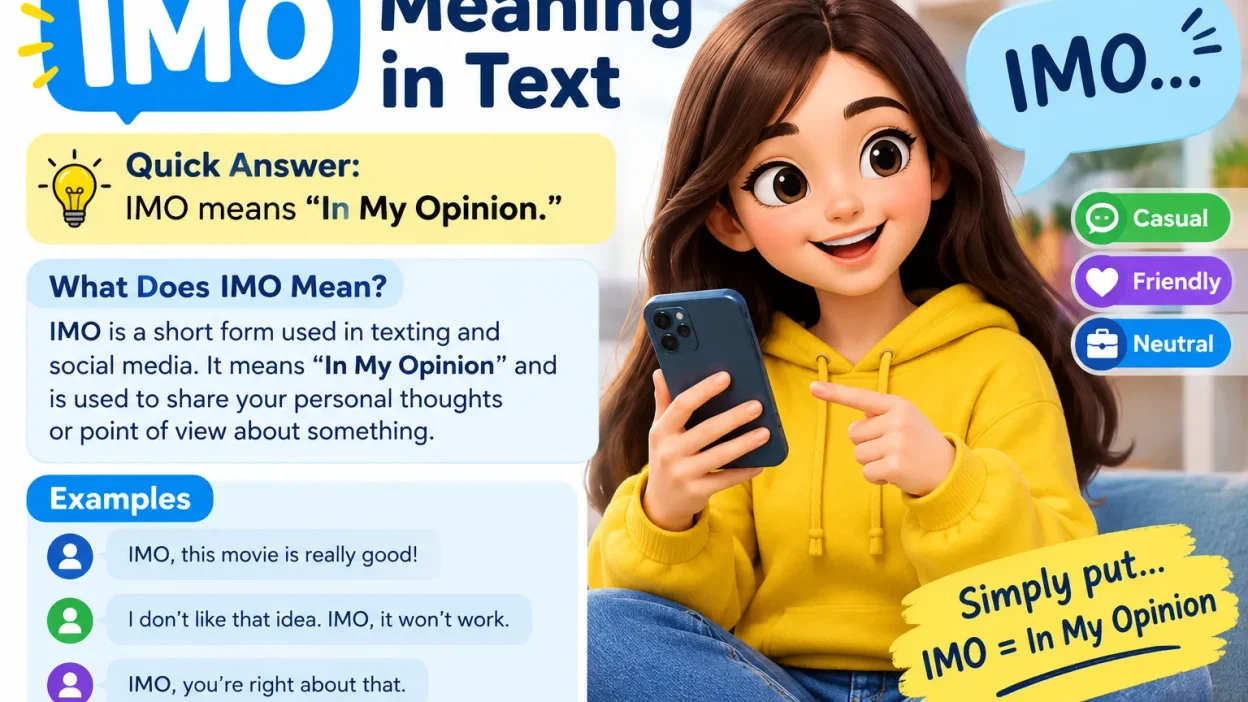
Quick Answer:
IMO means “In My Opinion.” It’s a casual way of sharing your personal thoughts, feelings, or beliefs about something.
What Does IMO Mean in Text?
IMO stands for “In My Opinion.” People use it in text messages and online conversations when they want to share what they think about a topic.
Instead of typing a complete phrase like “in my opinion,” you can simply write IMO to make your message shorter and easier to read.
For example, imagine your friend asks which movie is worth watching. You could reply:
“IMO, the new comedy is much better 😂”
This means you personally think the comedy is better, but you understand that other people might have different opinions.
IMO is commonly used when discussing movies, music, food, fashion, games, relationships, and everyday decisions. It can also make a statement sound less absolute because you are presenting it as your personal view rather than an unquestionable fact.
However, the tone depends on the conversation. IMO can sound friendly and helpful, but it may also sound critical if you use it before a negative comment.
In short: IMO = In My Opinion = What I personally think about something.
What Does IMO Mean on Social Media?
On social media, IMO has the same meaning: “In My Opinion.”
People often use it when commenting on posts, discussing trending topics, or responding to someone else’s ideas.
For example:
- “IMO, this song deserves more attention 🎶”
- “That outfit looks amazing, IMO 😍”
- “IMO, this game is better than the first one 🎮”
The abbreviation helps people express their views quickly without writing long comments.
Where Is IMO Commonly Used?
IMO appears across many digital platforms because it is short, familiar, and easy to type.
Here are some common places where you might see it.
- 📱 Text messages: Friends use IMO when discussing plans, sharing recommendations, or giving personal opinions.
- 👻 Snapchat: People may use IMO in direct messages when talking about photos, outfits, or everyday experiences.
- 🎵 TikTok: Users include IMO in comments about viral videos, music, trends, and popular creators.
- 📸 Instagram: It can appear in comments, captions, and direct messages when someone shares their perspective.
- 🎮 Gaming chats: Players use IMO to discuss strategies, characters, maps, and which games are worth playing.
- 💬 WhatsApp and Messenger: IMO is useful in group chats when people compare ideas or make decisions.
- 🖥️ Online forums: People use IMO when discussing products, technology, entertainment, or other topics.
Is IMO Formal or Informal?
IMO is mainly an informal abbreviation. It works well in casual conversations and most social media discussions.
You can use it with friends, relatives, classmates, and online communities. In professional settings, however, writing “in my opinion” is usually clearer and more appropriate, especially in formal reports, business emails, and important discussions.
Examples of IMO in Conversation
The easiest way to understand IMO is to see how people use it in everyday messages.
Here are seven realistic examples.
1. Talking About Movies
A: which movie should we watch tonight? 🎬
B: IMO, the new action movie looks better lol
Meaning: The speaker personally thinks the action movie is the better choice.
2. Discussing Music
A: have you heard that new song?
B: yes!! IMO, it’s their best song yet 🎶
Meaning: The speaker believes the new song is the best one the artist has released.
3. Sharing a Fashion Opinion
A: do these shoes look good with my outfit? 👟
B: IMO, they look perfect together 😍
Meaning: The speaker is sharing a personal opinion about the outfit.
4. Talking About Food
A: pizza or burgers? 🍕🍔
B: pizza, IMO. especially with extra cheese 😂
Meaning: The speaker personally prefers pizza.
5. Discussing Video Games
A: which character should i choose?
B: IMO, go with the faster one. it’ll help you win 🎮
Meaning: The speaker is offering a recommendation based on their own judgment.
6. Giving Friendly Advice
A: should i message him first?
B: IMO, yes! there’s nothing wrong with starting a conversation 😊
Meaning: The speaker believes sending the first message is a good idea.
7. Disagreeing Politely
A: i think the old version was better
B: fair, but IMO the new version is easier to use
Meaning: The speaker respectfully shares a different perspective.
These examples show that IMO can express preferences, recommendations, agreement, and disagreement. The abbreviation itself is neutral; the words around it determine whether the message sounds supportive, playful, or critical.
When to Use and When Not to Use IMO
Although IMO is useful in everyday conversations, it is not suitable for every situation.
✅ When to Use IMO
Use IMO when you want to:
- Share your personal opinion about a movie, song, or game.
- Recommend something to a friend.
- Explain why you prefer one option over another.
- Join a casual discussion on social media.
- Disagree with someone while making it clear that you are sharing your own perspective.
- Keep a text message short and conversational.
Examples:
“IMO, we should leave early to avoid traffic.”
“IMO, that was the funniest episode 😂”
❌ When Not to Use IMO
Avoid using IMO when:
- Writing a formal business email or professional report.
- Communicating important legal, medical, or financial information that requires precise wording.
- Giving urgent instructions where clarity matters more than brevity.
- Making a statement that needs evidence rather than personal opinion.
- Discussing a sensitive subject where the abbreviation might make your message seem dismissive.
For example, instead of writing “IMO, you should review this report,” in a formal email, write “I recommend reviewing this report before submission.”
IMO Examples for Different Contexts
| Context | Example Phrase | Why It Works |
| Friend Chat | “IMO, this place is amazing 😄” | Casual and friendly |
| Group Chat | “IMO, let’s meet at 6.” | Shares a suggestion |
| Work Chat | “In my opinion, option B is more practical.” | Clear and professional |
| “In my opinion, the proposal needs further review.” | More formal and precise | |
| Social Media | “IMO, this trend is getting old 😂” | Natural and conversational |
The main rule is simple: use IMO when the conversation is informal and your personal perspective is relevant. Spell it out when a more professional tone is needed.
Similar Slang Words or Alternatives
IMO is not the only abbreviation people use to express opinions online. Several other expressions have similar meanings, although their tone and usage can differ.
| Slang | Meaning | When to Use |
| IMHO | In My Humble Opinion | Sharing a view, often with a modest tone |
| TBH | To Be Honest | Expressing an honest thought or feeling |
| IIRC | If I Recall Correctly | Sharing information with some uncertainty |
| AFAIK | As Far As I Know | Explaining what you currently know |
| FYI | For Your Information | Sharing useful information |
| IMO, IDK | In My Opinion, I Don’t Know | Giving a tentative opinion while admitting uncertainty |
IMO vs. IMHO
IMO means “In My Opinion,” while IMHO means “In My Humble Opinion.” Both are used to share personal views. IMHO can sound more modest, although many people use the two abbreviations interchangeably.
IMO vs. TBH
IMO introduces a personal opinion, while TBH emphasizes honesty or frankness.
For example:
“IMO, that restaurant is the best in town.”
“TBH, I didn’t really enjoy the restaurant.”
The first expresses a judgment, while the second emphasizes an honest reaction.
IMO vs. FYI
IMO shares what someone thinks, whereas FYI introduces information that may be useful to another person.
For example:
“IMO, we should book a table early.”
“FYI, the restaurant closes at 10 PM.”
Understanding these differences can help you choose the right abbreviation for your message.
FAQs About IMO Meaning in Text
1. What does IMO stand for in texting?
IMO stands for “In My Opinion.” People use it to share their personal thoughts, preferences, or beliefs in text messages and online conversations.
2. What does IMO mean on Snapchat?
On Snapchat, IMO means “In My Opinion.” Someone might use it when discussing a photo, sharing advice, or giving their personal view.
3. What does IMO mean on TikTok?
On TikTok, IMO is commonly used in comments and discussions to introduce a personal opinion about a video, trend, creator, or topic.
4. Is IMO slang?
Yes, IMO is an internet abbreviation commonly treated as informal texting slang. It stands for “In My Opinion.”
5. Is IMO rude?
No, IMO is not inherently rude. However, a negative statement following it may sound harsh depending on the words and the situation.
6. What is the difference between IMO and IMHO?
IMO means “In My Opinion,” while IMHO means “In My Humble Opinion.” Both introduce personal views, and their meanings often overlap.
7. Can I use IMO in a professional email?
You can, but spelling out “in my opinion” is generally more appropriate in formal emails, reports, and business communications.
8. Does IMO mean the same thing in every conversation?
Usually, yes. In everyday texting and social media, IMO generally means “In My Opinion.” The context determines what opinion the person is expressing.
9. How do you reply when someone says IMO?
You can agree, disagree politely, or ask a follow-up question.
For example: “I agree with you!” or “That’s fair, but I see it differently.”
10. What is the opposite of IMO?
There is no exact opposite of IMO. Depending on the context, someone might use “IMHO” for a more modest opinion or present a statement as an established fact rather than a personal view.
Final Thoughts
IMO is a simple abbreviation that makes online conversations quicker and more natural. It stands for “In My Opinion” and helps you share your thoughts without typing the full phrase every time.
You can use it when discussing movies, music, games, fashion, or everyday decisions with friends. Just remember that IMO introduces a personal perspective, not necessarily a proven fact. If you are writing a formal email or professional document, spelling out the phrase is often a better choice.
Now that you know what IMO means, you can recognize it easily and use it confidently in your next text conversation.

William Brooks is a passionate writer who shares clear, practical insights on grammar, language, and everyday English. Her articles on GrammarWises.com help readers improve their writing and communication skills.